VIKTORIYA GOTSEVA

BABY GARDEN

Graduation Design Academy Eindhoven

2022

Baby Garden is a design proposal for an innovative natural playground for children aged 0 to 18 months, located in the community garden of Het Wijkpaleis, Rotterdam.

The project aims to make a step towards an improvement of the current urban reality in which outdoor spaces and playgrounds are still not meeting the needs of small children under the age of two.

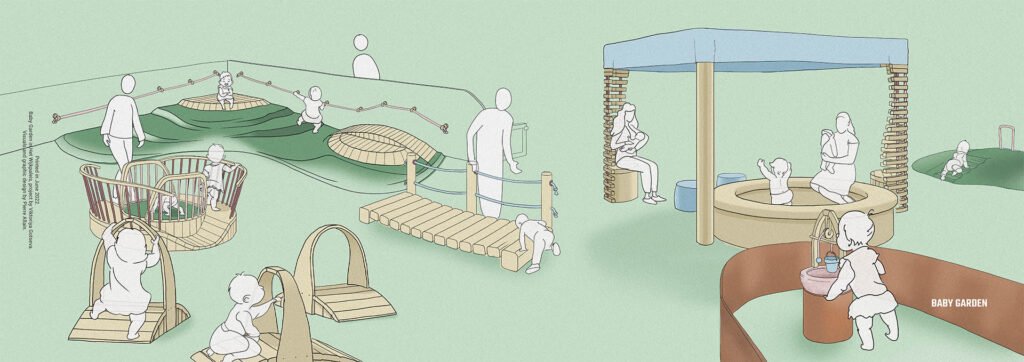
By applying the concepts of free movement in a prepared environment and implementing the main principles of affordances, the space offers appropriate play equipment to babies in green natural surroundings. In the garden, caregivers will get the opportunities to relax and socialize while their little ones independently explore and develop new skills.
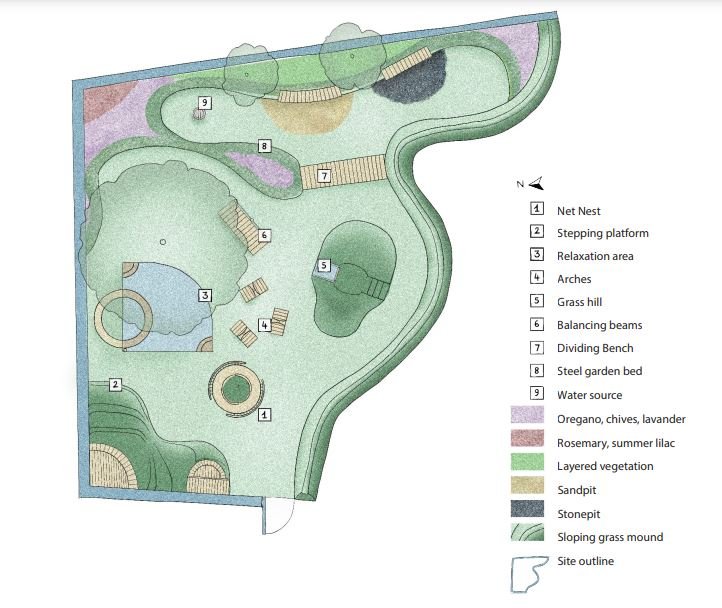
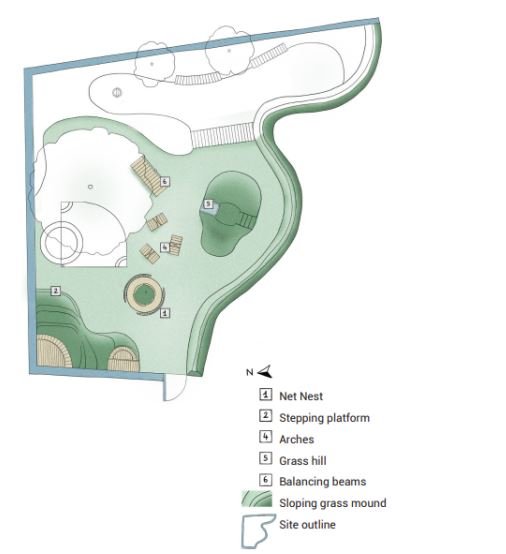
THE GARDEN IS DIVIDED IN 3 AREAS

Relaxation area

Sensorial area

Active area

The human brain develops up to 80% of its capacity in the first three years – a fundamental period for lifelong health and well-being. Young children
should have the chance to freely explore nature and develop their motor skills and senses. If offered the right environment, equipment and approach,
babies and toddlers would surprise us with what they are capable of

ACTIVE PLAY

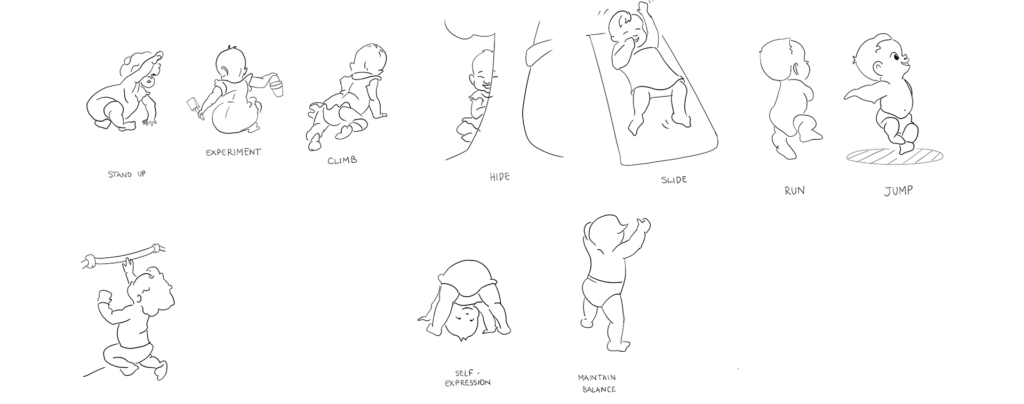
This play area is designed to stimulate babies and encourage them to develop new skills, by offering play equipment in scale to their sizes, abilities, and developmental levels. The garden will provide a series of graduated challenges, appropriate for age-related abilities and perceived as possible to undertake by the children.

The equipment is accessible to children with disabilities and encourages integration within the playground. Low accessible structures with a maximum fall height of 15 cm., wide platforms to ensure babies’ free movement, supporting handrails, and protective barriers will provide a safe play and encourage the little ones to do by themselves and gain self– confidence.

Depending on the age and abilities of each baby, a little help from an adult might be needed, but the design of equipment brings that need to a minimum in comparison with common playgrounds. This would give a chance for the caregivers to sit back and relax, while proudly observing their children’s accomplishments.

“Setting up an optimal level
of challenge and offering help
only when needed cultivates
a child’s perseverance and
problem-solving skills.”

Active area

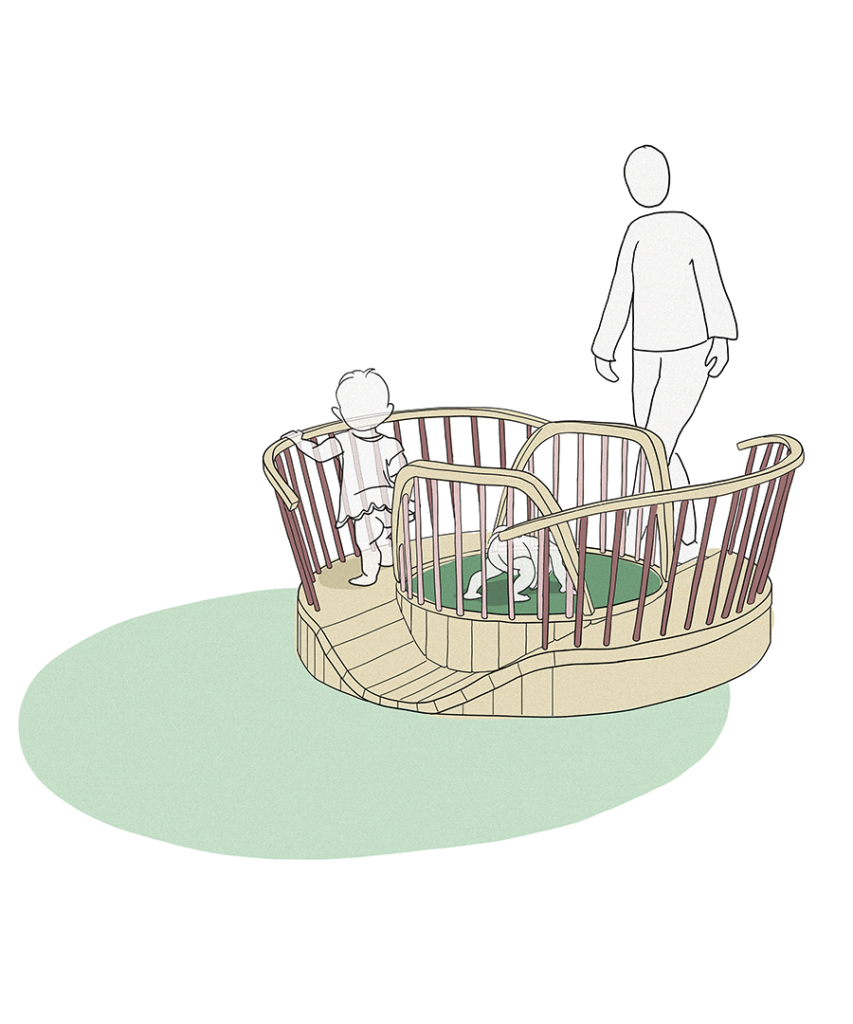
NET NEST

This net nest is an exciting object to explore, allowing babies to reach the centre from two different accesses: stairs or slope. The slightly elastic fine net would allow the little ones to gently bounce and explore the different movements of their bodies in a safe way. A walk around the barrier, both from in and outside can be especially intriguing and satisfying for those who are still learning to walk without any support. If needed, parents can quickly and easily reach their children by bending over the platform or walking in.

BENEFITS Gentle bouncing encourages balance, coordination, and strength. The unstable surface is great for developing the muscles in children’s feet and stimulates micro-movements that encourage overall postural stability. It increases the proprioceptive and vestibular function, which help achieve smooth movements in the daily activities, such as running to kick a ball, climbing on a playground, getting dressed.

PROPRIOCEPTIVE SYSTEM The proprioceptive system helps the body understand its position in space via feedback from the muscles and joints to the brain. The bouncing impact on the net stimulates the muscles and joints, providing a great source of proprioceptive information to the brain. The vestibular system

THE VESTIBULAR SYSTEM is important for understanding the position of the head in space and keeping the body upright. The anti-gravity nature of bouncing on the net provides rich information about the position of the body. Flips, twists, and tumbles further challenge this system.

REQUIREMENTS A protective barrier, except for entrance and exit openings, is used to minimise the likelihood of accidental falls from the edge. The angle and height of the barrier discourage older children from climbing over. Distance of maximum 10 cm between vertical bars of the platform prevents from entrapment.

BEYOND THE BABY, THE PARENT

Being a parent of a young child is an incomparable stage of life. Time is flowing faster and priorities change. For many, these first years of parenting are incredibly complicated and challenging. The everyday routine, the gain of new responsibilities, and the change of focus can easily make them lose themselves in the spin of life. Studies show that around a third of parents experience some form of loneliness and social isolation.

Nuclear families have become the more predominant family structure and with increasingly weaker regional connections, information pertaining to childrearing is often sparse and difficult to come by, which significantly increases the levels of insecurity and loneliness among young parents. Mothers who experience a high degree of loneliness are likely to be depressed, which in turn leads to decreased self-esteem and poor health, and consequently the poor health of their children and, in some cases, even child abuse.

18% of parents whose youngest child is under one often feel left out, rising to 41% of parents whose youngest is two, and falling to 8% of parents whose youngest is eight. Young parents often feel guilty about doing activities purely for themselves. They prefer activities that benefit their children and if possible combine them with socializing.

Offering a space where parents and especially young mothers can meet, talk and share experiences while benefiting from the relaxing atmosphere is one of the main missions of the Baby Garden. Even more, creating such an environment within community spaces like het Wijkpaleis will indirectly make young parents and families familiar with the rich cultural and social life of the neighborhood community and invite them to become part of it